Flammable, toxic or corrosive? Find your class.
The nine UN hazard classes, what packing groups mean and where a safety data sheet gives them, with a class finder for common products. Then we move it by road: every class except explosives.
- 9 classesOne for every dangerous good
- Section 14Where the SDS gives the class
- Classes 2 to 9On our hazchem vehicles
From the SDS to the road.
- 01
Section 14
The safety data sheet’s transport section gives the UN number, the proper shipping name, the class and the packing group.
- 02
The class
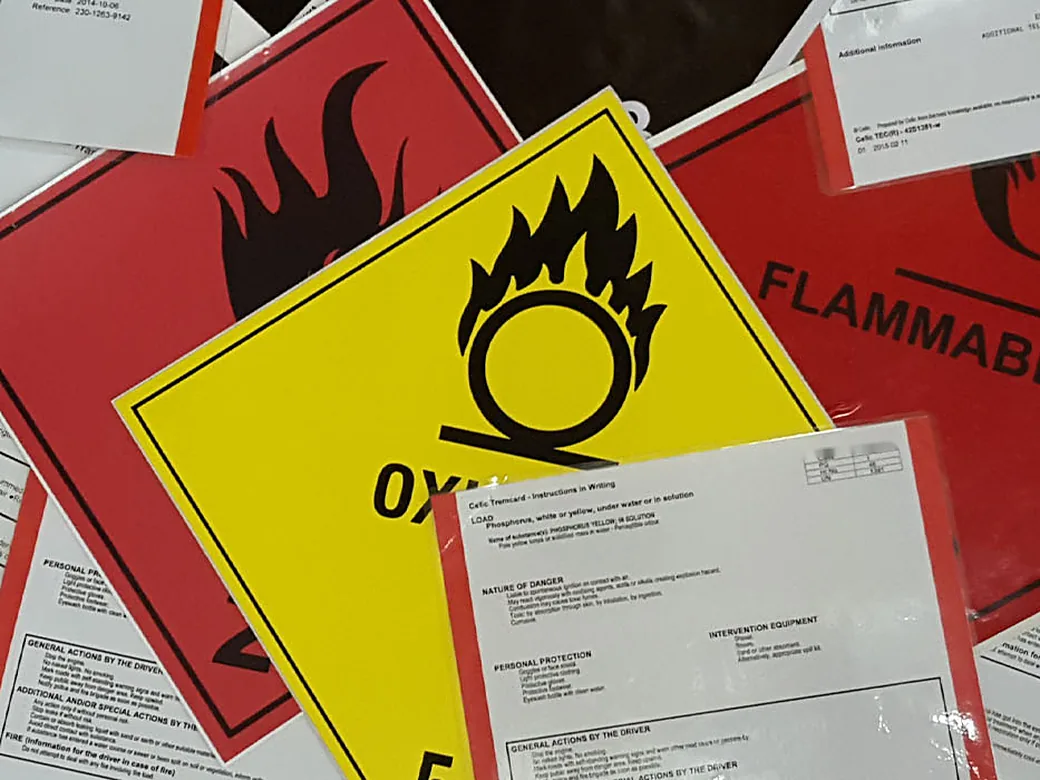
One of nine, by the main hazard. Paint is class 3, flammable liquids, and its label shows it.
- 03
Packing group
I, II or III: high, medium or low danger. Paint can be any of the three, by its flash point; this one is II.
- 04
On the road
The placards go on, the Tremcard rides in the cab, and we move it: every class except explosives.
Request a hazardous transport quote
Your load
Step 1 of 7- Packed as
- —
- Class
- —
- From
- —
- To
- —
- Quantity
- —
- When
- —
- Class finder
- Optional
Nine classes, three packing groups
Every dangerous good sits in one of nine UN classes, by its main hazard. The class number isn’t the order of danger: within a class, the packing group shows how dangerous a product is. From the UN Model Regulations, which South Africa’s SANS 10228 follows.
The nine classes
- 1 · ExplosivesDivisions 1.1 to 1.6. The one class we don’t move
- 2 · Gases2.1 flammable, 2.2 non-flammable and non-toxic, 2.3 toxic
- 3 · Flammable liquidsA flash point of 60 °C or below, like paint, petrol and diesel
- 4 · Flammable solids4.1 flammable solids, 4.2 spontaneously combustible, 4.3 dangerous when wet
- 5 · Oxidizers and peroxides5.1 oxidizing substances, 5.2 organic peroxides
- 6 · Toxic and infectious6.1 toxic substances, 6.2 infectious substances
- 7 · Radioactive materialNo divisions and no packing group
- 8 · CorrosivesAcids and alkalis, like hydrochloric acid and caustic soda
- 9 · MiscellaneousLithium batteries and environmentally hazardous substances, among others
Packing groups
- I · High dangerClass 3: boils at 35 °C or below
- II · Medium dangerClass 3: flash point below 23 °C
- III · Low dangerClass 3: flash point 23 to 60 °C
- No groupClasses 1, 2 and 7, and divisions 5.2 and 6.2
Read section 14
Section 14 of the safety data sheet gives the UN number (14.1), the proper shipping name (14.2), the class (14.3) and the packing group (14.4).
The consignor classifies
Under SANS 10228, which the National Road Traffic Regulations incorporate, the consignor classifies the goods. The product’s safety data sheet is where to start.
Every class but one
We move classes 2 to 9 by road, with a Tremcard for every UN-numbered product. Class 1 explosives is the one class we don’t.
Where we operate
We move hazardous goods by road from our depot at 69–71 Barlow Road, Jupiter, Germiston, where a hazchem section is accredited by Ekurhuleni for storing various hazard classes, and bring hazardous containers from Durban’s port through the depot to you, with one provider.
- Germiston depot69–71 Barlow Road, Jupiter, Germiston 011 873 4786
- Durban · Greyville81 Berea Road, Greyville, Durban 031 305 0438

Part of Shipping & General Transport
Shipping & General Transport is a privately owned South African logistics company built on trustworthiness, perseverance and reliability. Hazardous Transport is one of its specialist services: a guide to the hazard classes, with hazardous goods moved by road on hazchem vehicles, every class except explosives.
Visit shippingandgeneral.co.zaHazard class questions
Can’t find your answer? Our team is a phone call away.
Call 011 873 4786What are the nine hazard classes?
Class 1 explosives; class 2 gases; class 3 flammable liquids; class 4 flammable solids, spontaneously combustible substances and substances that give off flammable gas in water; class 5 oxidizing substances and organic peroxides; class 6 toxic and infectious substances; class 7 radioactive material; class 8 corrosives; and class 9 miscellaneous dangerous goods, including environmentally hazardous substances. Several classes are split into divisions, such as 2.1, 2.2 and 2.3.
Where do I find my product’s class?
In section 14 of its safety data sheet, “Transport information”: 14.1 is the UN number, 14.2 the proper shipping name, 14.3 the class and 14.4 the packing group. The label on the package shows the class too. Our class finder shows what to expect for common products.
What is a UN number?
A four-digit number from the UN’s list of dangerous goods, used with the proper shipping name to identify a substance or a group of them. UN1263 covers paint and paint-related material, UN1203 petrol and UN1824 caustic soda solution. It’s on the safety data sheet, the package and the vehicle’s placard.
What does the packing group mean?
How dangerous the product is, for packing purposes: packing group I is high danger, II medium and III low. Classes 1, 2 and 7, divisions 5.2 and 6.2, and self-reactive substances of division 4.1 don’t get one.
How is a flammable liquid’s packing group set?
By its flash point (closed cup) and initial boiling point. A liquid that boils at 35 °C or below is packing group I. Otherwise, a flash point below 23 °C is group II, and 23 to 60 °C is group III. Above 60 °C, it isn’t class 3; nor is a liquid with a flash point above 35 °C that doesn’t sustain combustion. Viscous paints and adhesives can go in group III after a viscosity test.
What is a subsidiary hazard?
A second hazard, listed after the class. Chlorine is division 2.3, toxic gas, with subsidiary hazards 5.1 and 8; compressed oxygen is 2.2 with 5.1; and hydrogen peroxide solution is 5.1 with 8.
Who decides the class?
The consignor: under SANS 10228, which the National Road Traffic Regulations incorporate and which follows the UN Model Regulations, the consignor classifies the goods. The safety data sheet from the supplier is the place to start. If you’re not sure, send it to us with your quote request.
Which classes do you move?
Every class except class 1 explosives. We comply with the National Road Traffic Act; our drivers train regularly and hold the certifications and licence endorsements the law requires; our hazchem vehicles are kept to full equipment spec; and we hold fire permit approvals from the local fire department. Placards, Tremcards and the declaration are on our dangerous goods site.
Can you store hazardous goods?
Our Germiston depot has a hazchem section, with Ekurhuleni municipality accreditation for storing various hazard classes, and it handles, grounds, stages and stores general and hazardous containers. Tell us the class and quantity and we’ll confirm.
How much does it cost?
Every load is different, so we don’t publish prices. Answer the seven short questions in the quote form, add the class finder if you like, and we come back with a quote on your actual load.
Tell us what needs to move.
Seven short questions, plus the class finder if you like. No prices online, just a quote on your actual load.